Magic Mountain 11

Magic Mountain 11
pen and ink on paper, 32 x 40 in.

Saturday, January 22, 2011

Excerpt: Dialogue between Allan Kaprow and Robert Smithson


I came across this dialogue between the artist Robert Smithson and the critic Allan Kaprow in a book of collected writings by Smithson. This conversation took place nearly a half century ago, yet seems like it could have occurred last week at any one of the contemporary art venues that also serve as symposium spaces around New York. It's rare to find a facet of contemporary art practice summed up so succinctly that it remains prescient after all these years.

.Excerpt.

What is a Museum?
A dialogue between Allan Kaprow and Robert Smithson, 1967


Smithson: I think you touched on an interesting area. It seems that all art is in some way a questioning of what value is, and it seems that there is great need for people to attribute value, to find a significant value. But this leads to many categories of value or no value. I think this shows all sorts of disorders and fractures and irrationalities. But I don’t really care about setting them right or making things in some ideal fashion. I think it's all there_independent of any kind of good or bad. The categories of "good art" and "bad art" belong to a commodity value system.

Kaprow:  As I said before, you face a social pressure which is hard to reconcile with your ideas. At present, galleries and museums are still the primary agency or "market: for what artists do. As the universities and federal education programs finance culture by building even more museums, you see the developing picture of contemporary patronage. Therefore, your involvement with "exhibition people", however well meant they are, is bound to defeat whatever position you take regarding the non-value of your activity. If you say it's neither good nor bad, the dealers and curators who appropriate it, who support you personally, will say or imply the opposite by whatever they do with it.

Smithson: Contemporary patronage is getting more public and less private. Good and bad are moral values. What we need are aesthetic values.

Kaprow: How can your position then be anything but ironic, forcing upon you at least a skepticism. How can you become anything except a kind of sly philosopher - a man with a smile of amusement on your face, whose every act is italicized?... the minute you start operating within a cultural context, whether it's the context of a group of artists and critics or whether it's the physical context of the museum or gallery, you automatically associate this uncertain identity with something certain. Someone assigns to it a new categorical name, usually a variant of some old one, and thus he continues his lineage of family system which makes it all credible. The standard fare of novelty is to be justified by history. Your position is thus ironic..

Smithson: I would say that it has a contradictory view of things. It’s basically a pointless position. But I think to take some kind of point right away stops any kind of possibility. I think the more points the better, you know, just an endless amount of points of view.


Saturday, January 8, 2011

Sexy Time on Shutter Island

I'm not a huge horror film aficionado, in fact, being a primarily visual thinker with an overly developed graphic imagination, I realized from a fairly early age that by and large the horror genre was not for me. This had nothing to do with any native squeamishness, on the contrary, I looked upon those bright fountains of crimson viscera spouting recklessly and chaotically as somatic equivalents to the choleric outbursts of tornadoes, hurricanes and earthquakes, and like those larger phenomena, the violence perpetrated on the body filled me with a mixture of awe, curiosity, excitement and dread at both the repugnance and the beauty of wounded flesh. The problem for me was never the watching, it was everything afterwards, once the lights were turned off and I fell in to an endless loop of reflective anguish, an echo chamber of carnage that I had no ability to turn off or mitigate. For the most part, I've outgrown these dreaded nocturnal episodes, though the sight of blood and guts (what Burroughs refers to as "flesh juice") still fascinates and repulses in equal measure (I still think the lyric "there's a body oozing blood" in the song "Mac the Knife" is one of the greatest things ever written).

Not long ago I read something interesting about how horror movies, made by and large for a teenage audience, serve as expressions of barely controllable, sometimes physically uncomfortable libidinal urges. The simultaneous sense of arousal and guilt that accompanies teenage attempts at lovemaking gives birth to a new dimension of anxiety that the Horror genre seems particularly adept at exploiting. Blood, after all is a kind of ejaculate, and death the ultimate climax (not to mention the blood that accompanies the loss of virginity in women). The hapless teenage couple cut down in the midst of a secret moment of coital bliss has become so familiar a trope that, like a piece of flan without its burnt underside, no horror movie would seem truly complete without it. The frantic woman running through a dark and thorny patch of wood is another cliché that seems indispensable and oddly satisfying. Sex and violence have always been linked in an assaultive embrace, one that the horror genre has adroitly evolved in to a succinct formula of stylized blood letting. The killer, almost always a male, is both romantic suitor, parental figure, jilted lover and avenging angel, by turns pursuing, seducing, trapping and ultimately punishing concupiscent teenagers for their bodily indiscretions.
The fact that the horror genre has so successfully codified these anxieties speaks volumes about our need to sublimate our fears even at the risk of creating new ones.

I recently watched the Scorsese film "Shutter Island" (which strictly speaking isn't a horror movie, its more of a suspense thriller, though it shares some connective tissue), and was struck by the realization that the way these films are constructed is as perverse as the subject matter. Most horror films aren't so much a streaming narrative as a quilt work of 5 to 10 minute episodes. These segments build up to a final moment of catharsis, but they can also be viewed individually as short films. Following a classic three part story structure, each segment has its own dramatic arc that builds towards its own moment of release. The beginning introduces the setting, the middle braces us for impact, and the end provides the prerequisite drama, some event that acts as both climax and coda, releasing our anxiety with a violent jolt. We are given a few moments to recover before the whole cycle begins again, and again and again.

Shutter Island is a perfect example of this, the entire movie is a series of short episodes. Each is succinct in its own way and can be isolated and viewed individually with little diminishment of enjoyment. The setting for the film is a mental institution located on an ominous island. As the story unravels, the setting is opened up for us like a puzzle, links and segments are presented, chambers are explored, each new setting becomes the fulcrum point for another point of action, another little story within the larger whole. In this sequential way the movie works it's way closer and closer to the end, ratcheting up the suspense with each successive place marker. There is a rhythm to Shutter Island as there is to most horror movies that is unmistakable. Its relentless yet utterly predictable, stimulation through repetition. These movies don't just confront physical desire metaphorically, they structurally embody the sex act as a series of brief, scary but ultimately exciting encounters. 


Thursday, November 18, 2010

The Currency of Change


Brands are engineered to have a powerful effect on the mind, like semaphores they point to deeper realities hidden beneath an instantly recognizable simplicity. Money, perhaps the oldest brand of all, is also one of the most elusively direct. Elusive, because it has to be both simple enough to trigger instant recognition yet elaborate enough to create an impression of rarefied mystique. This illusion serves many purposes but perhaps the most important is to make one believe, however briefly, in the notion that these flimsy pieces of paper actually contain some inherent value. It's as though the belief that phantom labor was exerted in the creation of money makes it more palatable for one to exchange ones actual labor for it.

Which brings me to some belated observations on the recent (well not so recent, it's been something like a decade now) redesign of American currency.
The redesign of all the American bills follows the same central strategy but for the purpose of simplicity I'll focus solely on the 5-dollar bill.. So here we go...  Observe the old 5-dollar bill, and boy does it look old, like something Buffalo Bill would gamble with on the set of Deadwood. Comparing the anachronistic, old world ornament of this bill to the new 5-dollar note, a few thoughts come to mind about American re-branding efforts in the 21st century.


The old bill is an elaborate affair, it's filigree borders have a floral arrangement completely absent in the new note. But, more importantly, the function these borders serve has drastically changed. They don't so much provide a frame for the image as create the appearance that what we are looking at is a stage, a theatrical enclosure reminiscent of the grand opera houses of the past. We are not merely consumers but witnesses to a great and sacred drama, the timeless theater of wealth, patriotism and politics. It's a seamless blend, a pageant of sorts with Lincoln filling the role of both leading man and grand marshal. Though, it should be noted, that it is not Lincoln himself that is depicted but his likeness, his official portrait enshrined amongst a bouquet of laurels. We may be in a theater but instead of a performance we are presented with a static, devotional arrangement like the kind found in a museum or religious temple. Lincoln's oval portrait is elegantly framed and takes center stage, resting atop a pedestal that announces the value of the note. From this central "alter" the remaining information is distributed in accordance with the rules of balance and symmetry. It should be noted that Lincoln's framed portrait is the only element that feels two dimensional, everything else, the curvy number 5, the banners, the elaborate writing all imply a 3D volume. This is a tangible space, one we are meant to enter in to through our gaze, an amalgamation of  theater, museum and temple meant to evoke historic certainty and inspire faith through worship. The back of the note makes this point more explicit. The Lincoln memorial is presented in a frame within a frame giving it the appearance of a magical place and, like the Parthenon for the Greeks, one we are encouraged to spiritually identify with.


In contrast, the new note employs none of these devices. Lincoln is large and in charge, no longer merely a portrait he is a living breathing leader of men. His self assured image dominates the picture plane. Rather than being set on a pedestal like a bust in a temple he actively advances towards the viewer breaking the plane of both the top and bottom banners. This point is emphasized by the asymmetry of his placement which is to the left of center. Whereas before he was a 2 dimensional object installed within a 3 dimensional space, he is now a fully realized incarnation surrounded by a flat space that serves to heighten the realism of his depiction. The borders at the top and bottom are simple and direct, evoking less a turn of the century theater/temple/museum and more the electronic banners at the bottom of a cable news broadcast where information moves swiftly and dispassionately from left to right. The purpose of the banners here is not to inspire awe, or place us inside a historical space, but to communicate information clearly and concisely. This approach is emphasized on the back of the bill where a simple, unadorned number 5 dominates the bottom right corner. The other fives may retain an old world charm, but they are an after thought to the declarative bluntness of their larger companion. Likewise, the Lincoln memorial is once again merely a memorial, to be sure it's still grand but this grandeur is not over emphasized with multiple borders and frames. Front to back this is a presentation that privileges clarity over ornament, motion over stasis and immediacy over mystique.


I'm not an expert on design but I think to a large degree these changes are in keeping with the overall tendencies in the graphic arts over the last several decades. We are living in the information age, and products have striven to reposition themselves as generally more dynamic, proactive participants in a world that is constantly beset by change. It stands to reason that the product that is the US economy would likewise want to appear to keep up. The new bills certainly make a case for this. The American obsession with leadership via the cult of personality is more than an attitude, it's a cultural export, one that has proven highly profitable in the past. Whereas the old notes communicate stability and historic certainty, the new ones emphasize a direct, streamlined simplicity meant to give the impression that ours is an agile economy alert to the challenges of the future. Lincoln is a dynamic force ready to take on the changing world, and by implication so are we. It's a significant shift in the way America wants to be perceived by the world. No longer the economic juggernaut, no longer as admired as it once was, there is a defiance in the new notes that contrasts sharply with the contentment of the old.  Ironically, as the years pass and the recent financial collapse takes on the clarity of a survived event, the heady, imperious swagger of this design may ultimately appear more anachronistic than the old.


Thursday, October 28, 2010

Process is More Important than Fact: William Kentridge in "Anything Can Happen"


The recent screening of a feature length documentary on William Kentridge at MOMA was eye opening. I'd always liked Kentridge from afar without having seen too much of his work in person.  To tell the truth I liked his work enough to respect him as an artist but not enough to actively seek it out. Coming from this ambivalent point of view, "Anything Can Happen" was a perception changing experience. The movie is filled with clips from Kentridges early cartoons, his Box projects and his resent forays in to theater and opera (he spent several years designing and directing Shostakovitch's "The Nose").

Stop motion is the most obvious thread that ties all of these endeavors together and
Kentridge uses it to rare expressive mastery. Kentridge's cartoons swirl out of a charcoal dust cloud, composing themselves amidst a chaotic uncertainty of smears and smudges that all too often mirrors the historic uncertainty of South Africa's troubled past. The only sense of resolution seems to be found in the act of erasure which is never fully realized. A penumbra of afterimages remain as both surface stains and temporal reminders that the movie might exist, but the original drawings that once comprised it have been destroyed in the birthing process that gave it life. A document survives but, like much of history it's a document whose very existence is made possible only by the destruction of the evidence that created it in the first place. It's a kind of post apartheid "Dance Macabre". A low tech waltz of life, death and perhaps at some point redemption.

However. as haunting and poetic as these cartoons are, its Kentridge's overall approach to the creative process that I was most impressed with. He spends most of the time talking not about the meaning behind his works but about the intuitive process that is so central to it's creation. He sees everything as a process, a long intervention, the outcome of which is determined less by intent than by accident. Early on in the film he says that for him "process is more important than fact", one could also say, engagement is more important then product. Indeed, the studio is presented as a kind of laboratory for ideas, perhaps even a playground. Judging by the copious interviews throughout the film, this is an association Kentridge would gladly welcome. It's as though his primary role as an artist is to develop the conditions in which his creativity can best flourish rather than itinerize the ends towards which it is deployed. 

I'm reminded of something Francis Bacon once said about seeing himself primarily as a human transmitter, picking up signals he knew not from where.  For him it was a kind of free association that he dared not question for fear that the act of inquiry would forever sever his connection to its source. I don't know if Kentridge shares this particular misgiving but he certainly shares the intent that motivates it. At one point he declares "I believe that if you work persistently, whatever is of interest inside you will eventually come out". I think a strong  corollary can be drawn between the ability to dedicate ones life to persistent work and the mental attitude that  privileges creative  process over specific outcome.


Tuesday, October 19, 2010

Notes on the Charles Burchfield Retrospective


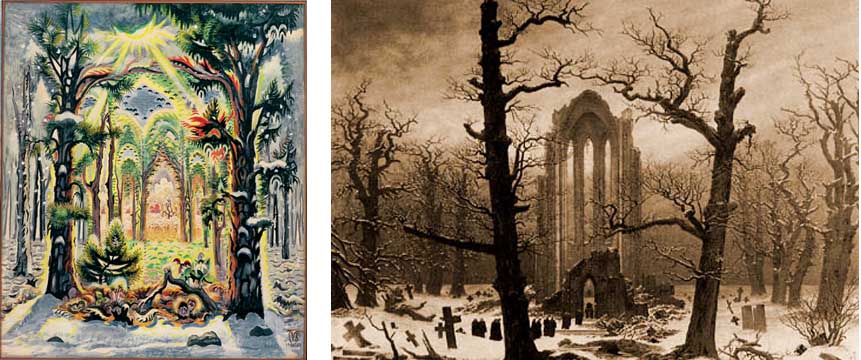
Charles Burchfield's retrospective at The Whitney Museum of American Art affords a rare opportunity to see one of Americas most under appreciated artist. Burchfield's always had a special place in my heart. He's a strange figure that refuses easy catagorization. Part iconoclast, part visionary and part kook, he's an artist who seems at once anachronistically romantic and vigorously contemporary. But, regardless of these distinctions there is no denying that the work is beautifully weird. It's as though someone slipped Casper David Freidrich a couple of tabs of acid before letting him loose in the Hudson Valley with a set of watercolors.


Burchfield committed himself to a personal vision of the world wholly at odds with the current trends of the day. It's a vision of ecstasy mingled with mortal dread. For Burchfield, nature personifies spiritual interiority that is visionary in nature. As with Friedrich, the contemplation of the natural world is seen as a religious experience ultimately leading to self awakening. 


Indeed, both artists would paint cathedrals in the forest, Friedrich paints an actual structure surrounded by mist and ancient oak trees. Burchfield paints a forest whose trees form the open windows of a stained glass facade, giving way to a vision of the four seasons. In each case the most important thing for the artist is not simply to communicate an idea, or even convey an impression but to wholly immerse the viewer in a vision. To put the viewer in a state of contemplative wonderment giving way to a sense of temporal transport. 


Themes of life, death and re-berth predominate and one ultimately gets the feeling that, for Burchfield, these are not just themes but heartfelt truths he struggles his whole life to communicate. In fact, this very earnestness is perhaps the  one attribute which most clearly betrays Burchfeld as a painter of an older generation. There is no irony here, no cynicism, just a kaleidoscopic intensity that at times is almost too much to bear.

Friday, October 15, 2010

Alfred Leslie's Declarative America


Alfred Leslie's abstract work from the early 50's to the mid 60's is characterized by bold, splashy brushstrokes that were so irresistibly popular at the time. But, in almost every painting, collage and mixed media piece Leslie created during this period, he adds an element that seems to have an almost defiant relationship to the tradition of gestural abstraction he is working in. Two vertical bands of color usually made of a single thick brush stroke each, invariably appear prominently placed somewhere within the image. These vertical bands are Leslie's distinguishing gesture, a kind of brand he repeats over and over again. The redundancy is so consistent that, one can argue, these marks constitute a form of signature, Leslie's private rebus with which he stakes a claim to a slice of the Abstract Expressionist Pie.

There is something uniquely American about these marks that I think bears discussing. Abstract Expressionist painters may have aspired to a purely American vision yet always seemed to have one eye turned towards Europe. Either formally or conceptually there is a preoccupation with the elaborate, the refined and the virtuosic. Even Pollock, the most brash and cowboy member of the group is ultimately betrayed by a lyricism that owes much to Picasso and the Surrealists.

Which isn't to say that Leslie does not, I think he is a kind of bridge figure, offering both a summation of the recent past and a protean augury of the immediate future. Pop art was In Utero, but before we could get all giddy for those stacks of soup cans and blown up comic strips we had to travel through the smoke filled landscape of the Beat Generation. This is where Leslie comes in, his paintings are both an urban alarm clock and a European lullaby.

They are atmospheric and undeniably beautiful, full of the kind of heroic gusto that was believed to authenticate a true work of art. What could be more European than the need for such overt proof of vitality? Leslie provides this proof, and then inexplicably he cancels it out with those two vertical bands. Like a schoolboy using two lines to cross out a misspelled word in a notebook.

And, this is what I think these marks ultimately are, a negation of European refinement. They make no claim to virtuosity, quite the opposite, they are declarative and blunt.  Anyone can make them, and that’s exactly the point, virtuosity is obsolete, direct statement is what matters. It's a shift in emphasis that has remained central for most artists to this day.

Wednesday, October 6, 2010

Florescent Enlightenment - Wayne Thiebaud and the Baroque Ideal


And the light shines in the darkness, and the darkness did not comprehend it.
John 1:5


Wayne Thiebaud is usually considered a pop artist, and like Hopper (who clearly is not), much has been written about the comment his work makes on the spiritual isolation in post war America. There is a loneliness beneath the surface of all those rows of confectionary goods that belies their cheerful appearance. There is also light, Thiebauds paintings are suffused in it. It permeates his backgrounds so completely that his subjects appear trapped in its glow, like flies suspended in chips of amber. They are on display, but the stage is an abstraction and light is the world made featureless.

Light has always been the secret subject of painting, it is immaterial but fecund with symbolic and metaphysical content. In Baroque paintings this is especially evident. Figures appear out of the darkness as though materializing from a deep, inky abyss. It's not just a physical illumination that we are witnessing, but a spiritual and intellectual one as well. Here, darkness is a manifestation of ignorance, Godlessness, and even madness. It is our primordial past. Light on the other hand is knowledge, civilization and God. On the cusp of the Enlightenment, the artist is depicting the awakening of civilization . Man leaves the darkness of his past through the light of rational thought and spiritual faith. An artistic aspiration mirrors this humanistic one. The painter is staking a claim to his own part in this process, no longer content to be considered a mere craftsman he moves in to the light of recognition as a culturally important figure.

So, Baroque painting, in all of its chiaroscuro, candle lit drama is actually about the coming of age of both mankind and the artist. Both are moving from darkness to light, from ignorance and obscurity to knowledge and recognition. Light is not shining on them as such, instead the subject and by implication the artist, are actively entering in to its glow. Rationality and faith are fused in to one as mankind transcends his ignorance.  We are witnessing a tripartite alchemy of the soul, the subject, the artist and lastly our own.

These are deeply hopeful paintings, they assert a trajectory of human development that would be elaborated upon for the next 2 hundred years. If light is knowledge leading us to progress,  then it was assumed each successive generation would increase the aperture of illumination. It's a breathtaking journey, one that came to a swift end with the 20th century.

Like the baroque painters before him, Thiebaud places his subjects in the center. As far as he is concerned nothing else exists in the universe. Thiebauds figures are in the light completely, but, there is no conquering of the elements, instead of transcendence there is a blank objectivity. These paintings are not hopeful, they are remorseless, oddly happy on some level, but mostly aware that the ideal of progress is an empty promise..

Thiebauds paintings  aren't so much the natural extensions of their Baroque predecessors as their dialectic opposites. Looking at this work is like looking at a negative image of a Rembrandt. Where there was darkness there is now nothing but clear, featureless, light. This "all over" light is unprecedented in painting and is not just a visual device. The Baroque painters painted by candlelight, the impressionists by sunlight, Thiebaud on the other hand, working in post WWII America, is painting the light of the  florescent bulb. A democratic light unique to the 20th century that privileges nothing and at the same time makes a commodity out of everything. In Thiebauds paintings the world has been made in to a giant display case.  There is no active relationship between the subject and the environment. One no longer feels that the figure is moving towards or away from a light source. The figures are static, the light is static, time is static.

So one can argue, Thiebaud's paintings are about failure. The failure of progress in the 20th century. Prosperity and knowledge have led us to a world illuminated not by the Divine but by an artificial, ceaseless machine. It is a strange and oddly still dead end.